Client: Intelight
Case study
Intelight – digitalization of manufacturer sales in the closed B2B portal model


Starting point
Traditional sales from the manufacturer versus reality:
traders are drowning in administration
Intelight operated exactly like most manufacturers in Poland. Salespeople built relationships, negotiated terms, and processed every order manually. Phone, email, spreadsheet. Every price inquiry, every availability check, every delivery confirmation – all by human means.
The problem wasn't with the people or processes per se. It lay in the lack of a tool that could handle the manufacturer's unique characteristics: complex discount groups, inventory levels that differentiate between what's in stock and what can be produced, and a customer structure where each company has its own terms, users, and order history.
A standard "B2B store" doesn't solve this problem – because Intelight didn't need a store open to everyone. It needed a closed system for verified partners that would also become a working tool for the sales department. This was the basis of the project.


Have any questions?
Let's talk about cooperation.
What have we implemented in the closed B2B system?
A portal that operates on two levels simultaneously – a self-service channel for customers and an operational tool for the entire sales department. Below are six areas that collectively contributed to this transformation.

Closed access and customer account management
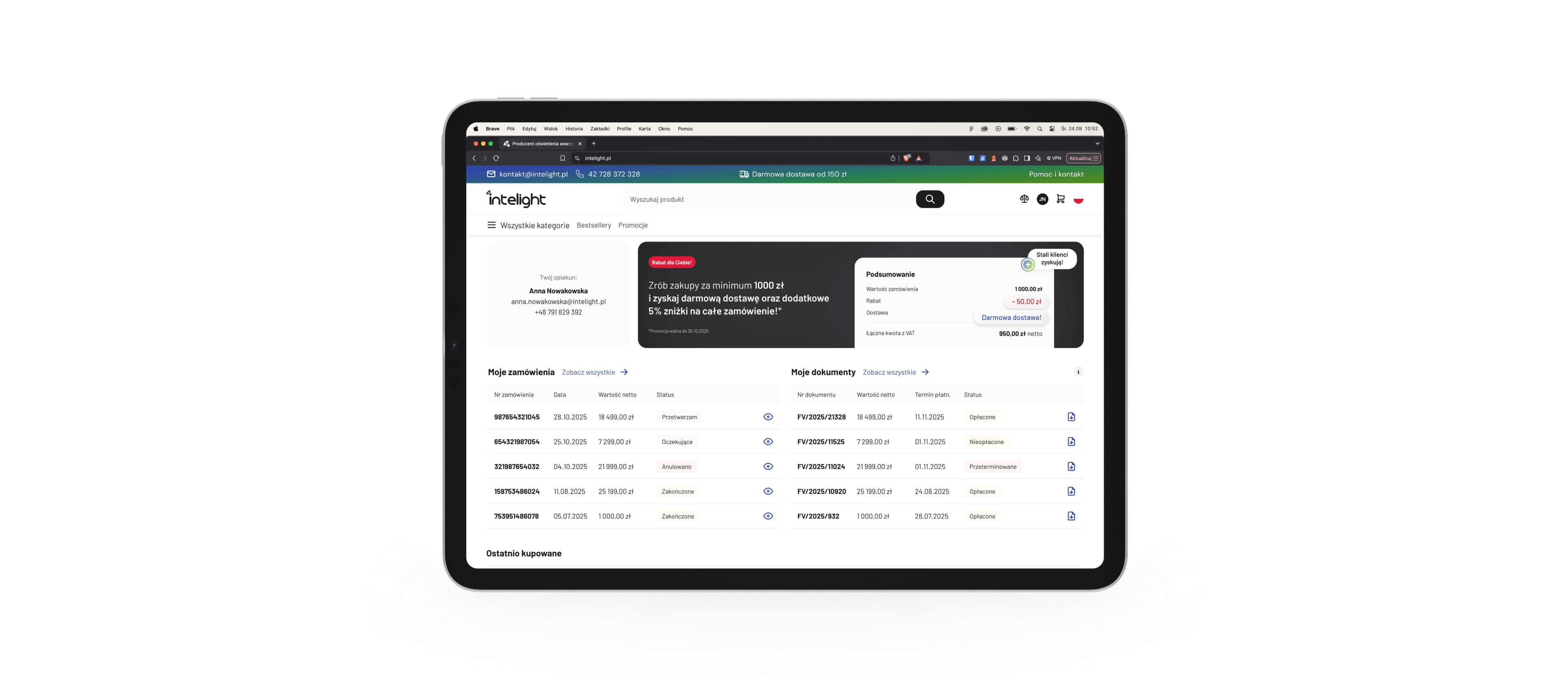
No public registration. Accounts are created by the administrator or after manual verification – Intelight controls who has access to the system and under what conditions. A single client can have multiple users assigned to the same company account, each with different permissions. This isn't a store – it's a work environment for business partners.
A personalized shopping experience for each group
The customer dashboard isn't uniform. Each customer group sees a different page layout, different banners, and different information modules—tailored to their purchasing profile and relationship with Intelight. Product descriptions built with HTML and CSS allow for a rich technical presentation of advanced lighting systems—where a PDF with a catalog card isn't sufficient.
Hierarchy of salespeople with customer impersonation
The Head of Sales manages the team and assigns customers to specific salespeople. After logging in, each salesperson sees only their own customers and their orders—without access to the data of others. Furthermore, salespeople can log in directly to the customer's account, view offers from their perspective, create shopping lists, and assemble carts on their behalf. Fieldwork takes on a whole new dimension—salespeople don't call the office; they work within the system alongside the customer.
Smart pricing policy: dynamic thresholds and discounts
Customers are assigned to discount groups – that's standard. But with Intelight, we've added a layer that most systems don't: an algorithm that, once a certain basket value is exceeded, automatically assigns the customer the lowest price available in the entire system, regardless of their group. The more you buy, the system automatically selects the best rate. Plus, there's a discount mechanism: selected customer groups have two bank transfer payment options. Choosing a shorter payment term automatically grants a discount on the entire order. No manual intervention required.
Two types of availability: warehouse and production
Intelight is a manufacturer, not a distributor, so "stock" has a different meaning here than in typical e-commerce . Customers see two types of availability: how many items are physically in stock, and how many the factory can produce within a given timeframe. For example, the system indicates that another 1000 units of a given product can be ordered within 14 days. This information is not provided with equal precision by any price list or phone call. When processing multi-product orders, the system automatically divides them by source warehouses – the customer doesn't need to know where each item is coming from.
Integration with ERP at the single-item level
We've expanded the connection to Subiekt GT via Sapsyn beyond the standard integrator capabilities. The system exchanges information with the ERP about waybill numbers associated with delivery notes. The result: the customer sees the fulfillment status in the portal not as "order in progress," but precisely – which items have already left the warehouse and which have not yet. Another change to the process: order confirmation is no longer sent automatically after placement; it only reaches the customer once the order has passed Intelight's verification and been correctly processed in the ERP. This is a subtle change, visible to the customer, but fundamental to the reliability of the process.

Effect: one system, two levels of value
The portal solves two problems at once – on the customer side and on the sales department side.
Contractors:
self-service without losing relationships
Verified partners have their own purchasing environment tailored to their group and circumstances. They can see their pricing, actual availability, and production schedule, place orders, and track each item until shipment. Ordering independence doesn't mean a lack of support—the merchant can still interact with the customer within the system when needed.
Traders:
from operator to advisor
Automated pricing, customer impersonation, and visibility only to your own customers eliminate most administrative tasks from the team's daily work. Salespeople are no longer just order processors – they're advisors who have the full customer context in one place and can focus on what actually generates value.
Sellina as a closed system:
the first implementation of this type
Intelight is proof that Sellina doesn't have to be a brick-and-mortar store. The platform has managed to address complex manufacturing requirements—role hierarchy, multi-currency and multi-lingual support, advanced pricing groups, and custom ERP integration —in a model where each customer must first be verified. The system's design is driven by business needs, not technological limitations.
Deferred payment
without bureaucratic barriers
The implemented deferred payment method eliminates the need to rigidly define trade credit limits for each individual customer. This flexible approach reflects the realities of long-term commercial relationships in the manufacturing industry.
Do you run B2B sales with similar complexity?
We will show you what the digitization of the sales process looks like, tailored to the specifics of your business.
Discover our selected projects
See all case studies


Do you have an idea, a ready specification or a business need?
Write to us. We will contact you within 24 hours.